Nail salon + armor
A hoof is a hoof!
A hoof doesn’t need to look like a set of freshly manicured nails. It is protective armor for a body weighing between 1,100 and 1,500 pounds.
The Book
How hooves work. Your role in supporting them. Clearly explained.
If you’re holding this book, you’re probably frustrated. You sense that something isn’t quite right with your horse’s hooves.
This is not another book filled with X-rays, angle charts, and annotated tendons. There are already more than enough of those, and they have done little to improve the state of hoof care — if anything, the opposite. What I want to give you is a practical approach that works: clear, honest, and straight to the point.
What you’re holding is a hands-on manual. It teaches you how to read a hoof — and how to trim it accordingly. Guided by function, not dogma.
Nail salon + armor
A hoof is a hoof!
A hoof doesn’t need to look like a set of freshly manicured nails. It is protective armor for a body weighing between 1,100 and 1,500 pounds.
Shop shim
Think of your favorite pair of shoes. Not the prettiest pair, not the most expensive one — but the pair you instinctively reach for after a long day because they are simply comfortable. They may not look like something from a shop shim, but they fit. And that is exactly why they work so well.
What You Need Is the Sole
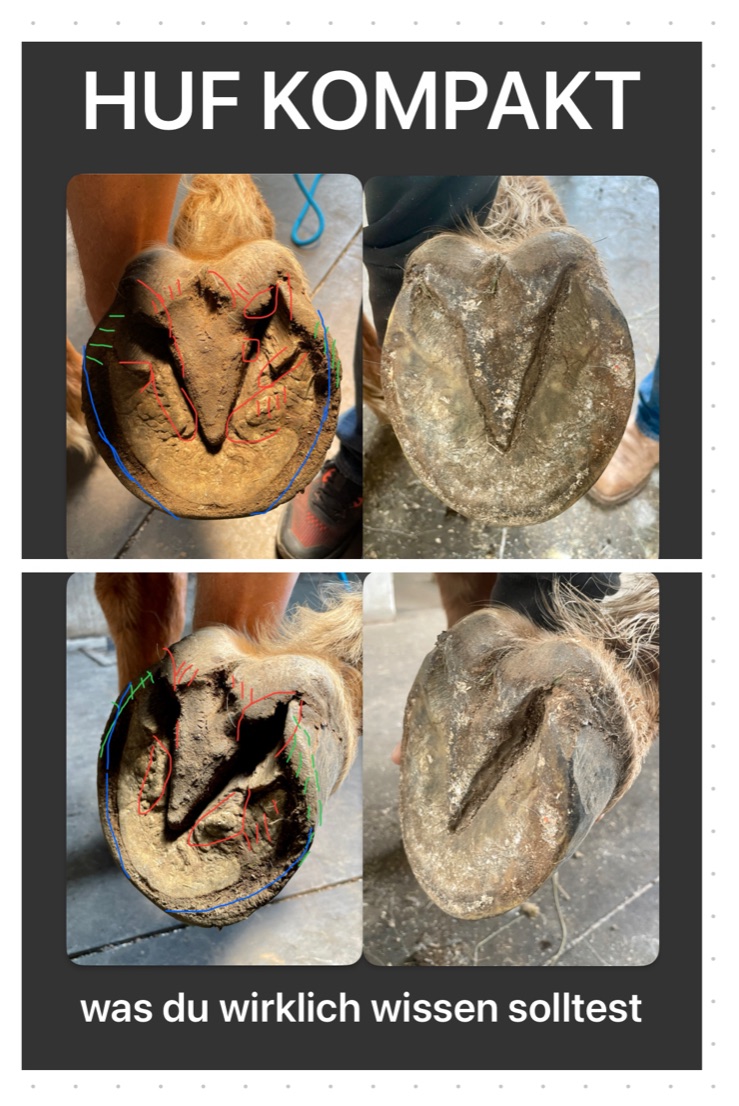
You don’t need to understand everything at once. You don’t need to know every contributing factor, interpret every change at the coronary band, or analyze every asymmetry along the hairline. What you really need is the sole.
The back of the hoof is its shock-absorbing system: the frog, heels, digital cushion, and lateral cartilages. Alternating compression and release create a pumping action that supports circulation and healthy growth.
Bowker 1998
With every step, it helps pump blood back into circulation.
Bowker 1998
The lower side is often the weaker one — and therefore the wrong reference point for balance. Instead of rasping down the stronger side, give the weaker side time to grow into the position where it belongs. That is how proper balance develops — not by forcing the stronger side down to match it.
Van Heel 2005 · O'Grady 2013